
Best Gold ETF 2026: GLD vs IAU vs GLDM Compared
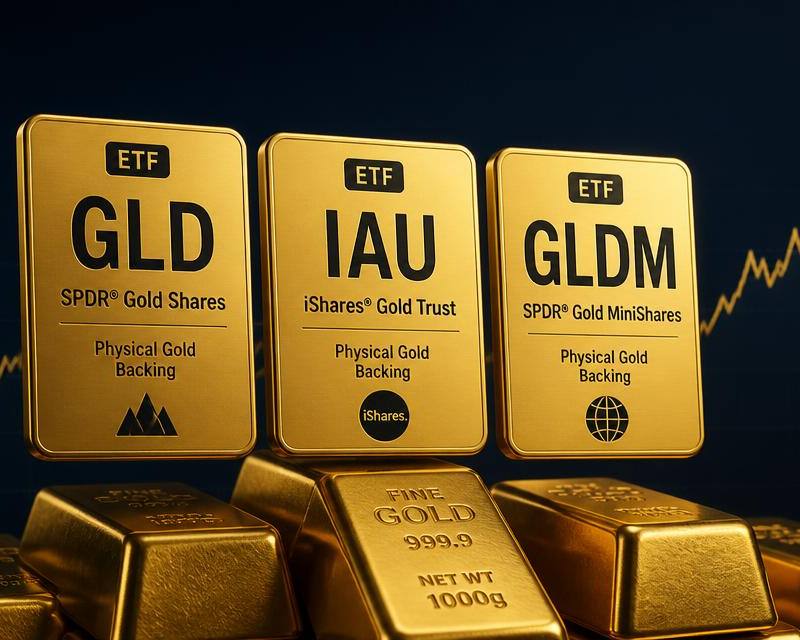
Compare the best gold ETFs for 2026 — GLD, IAU, GLDM, SGOL and the miners — on expense ratio, liquidity, structure and tax, with a clear pick for each type of buyer.
Short answer: for most long-term buyers the best gold ETF is GLDM (SPDR Gold MiniShares, 0.10%) or IAU (iShares Gold Trust, 0.25%) — both hold allocated physical bullion at a fraction of GLD's cost. GLD remains the right choice for large traders and options users because its liquidity is unmatched. Miner funds like GDX are not a substitute for gold.
Best gold ETFs 2026 at a glance
| Ticker | Fund | Type | Expense ratio | Best for |
|---|---|---|---|---|
| GLD | SPDR Gold Shares | Physical bullion trust | 0.40% | Deepest liquidity, options, large tickets |
| IAU | iShares Gold Trust | Physical bullion trust | 0.25% | Large, liquid and materially cheaper than GLD |
| GLDM | SPDR Gold MiniShares | Physical bullion trust | 0.10% | Lowest-cost long-term buy-and-hold |
| IAUM | iShares Gold Trust Micro | Physical bullion trust | 0.09% | Cheapest headline fee, smaller and less liquid |
| SGOL | abrdn Physical Gold Shares | Physical bullion trust | 0.17% | Swiss-vaulted bullion with published bar list |
| BAR | GraniteShares Gold Trust | Physical bullion trust | 0.17% | Low-cost alternative wrapper |
| OUNZ | VanEck Merk Gold Trust | Deliverable bullion trust | 0.25% | Investors who may want physical delivery |
| PHYS | Sprott Physical Gold Trust | Closed-end trust | ~0.41% | US investors seeking LTCG tax treatment via election |
| GDX | VanEck Gold Miners ETF | Equity — miners | 0.51% | Leveraged, higher-beta play on the gold price |
| GDXJ | VanEck Junior Gold Miners ETF | Equity — junior miners | 0.52% | Highest risk/reward in the complex |
| RING | iShares MSCI Global Gold Miners | Equity — miners | 0.39% | Cheapest broad miner exposure |
Expense ratios are the issuers' published figures. They change rarely, but check the fact sheet before you buy — the sources at the end of this article link straight to each fund page.
The cheapest gold ETF: fees compound, even on a hedge
Gold pays no dividend and no coupon, so the expense ratio is a straight drag on the only return you get — the price of the metal. Over a decade the difference between 0.40% and 0.10% on a $50,000 position is roughly $1,500 of forgone value before compounding, on an asset most people hold precisely because they intend never to trade it.
That is why the issuers launched "mini" share classes. GLDM is State Street's low-fee answer to GLD, and IAUM is BlackRock's answer to IAU. Both hold allocated bullion in exactly the same way as their larger siblings; the difference is fee, share price per unit and secondary-market depth. If you are buying and holding, the cheap share class wins. If you are trading size or writing options, it usually does not — see the next section.
GLD vs IAU vs GLDM
GLD is the original and by far the largest US gold ETF. Its advantage is not cost — at 0.40% it is the most expensive of the three — but market structure. GLD has the tightest bid/ask spreads in the largest sizes and the deepest listed options market of any gold product. Institutions, hedgers and anyone trading blocks or expressing views with options should sit in GLD and treat the higher fee as an execution cost, not a management fee.
IAU is the sensible middle ground: still very large and liquid, but 15 basis points cheaper than GLD. For a five- or six-figure position held for years, IAU has historically been the default "cheap but liquid" answer, and it retains a real options market.
GLDM is the cost leader among the large funds at 0.10%. Its lower share price also makes it easier to size precisely in small accounts. The trade-off is a thinner options market and slightly wider spreads in large size. For a buy-and-hold allocation of 5-10% of a portfolio, that trade-off is almost always worth taking.
All three hold allocated, physically vaulted bullion and track the spot gold price after fees. Tracking difference between them is small; the fee is the dominant, predictable variable.
Miners are not gold: why GDX behaves differently
Gold miner ETFs are often marketed alongside bullion funds, but they are a different asset. GDX holds equities, so it carries operational risk, cost inflation, jurisdiction risk, share dilution and equity beta on top of the gold price. In practice miners behave like a leveraged, noisier expression of the metal: they can outperform sharply when gold rallies and margins expand, and underperform badly when gold is flat and costs rise.
Use miners as a satellite growth position if you have a strong view on the metal. Do not use them as the hedge — the whole point of a gold allocation is that it is uncorrelated to equity risk, and a basket of mining equities is not.
Gold ETF vs physical gold vs spot XAUUSD
A bullion ETF gives you exposure to the metal with brokerage-level liquidity, no storage cost and no dealer premium. Physical coins and bars give you title to the metal itself, with a buy/sell spread that is typically far wider than an ETF's, plus insurance and storage to arrange. OUNZ occupies the middle ground: an ETF wrapper that permits delivery of physical gold to holders who want it.
Active traders often use neither and trade spot XAUUSD instead, which offers round-the-clock hours and precise position sizing. That is a trading instrument, not a portfolio allocation — if you take that route, read our gold macro regimes lesson first and see how our desk structures gold trades on the gold signals hub.
Tax: the detail most gold ETF comparisons skip
In the United States, physically-backed bullion trusts such as GLD, IAU, GLDM and SGOL are treated as collectibles for tax purposes. Long-term gains are taxed at the collectibles rate — up to 28% — rather than the standard long-term capital gains rate that applies to equity ETFs. This is not a defect in any one fund; it is how the IRS treats the underlying metal.
Two workarounds exist. Holding a bullion ETF inside a tax-advantaged account sidesteps the issue entirely. Alternatively, Canadian closed-end trusts such as PHYS allow eligible US holders to make a QEF election, which can convert gains to standard long-term capital gains treatment — at the cost of extra filing and a share price that can trade at a premium or discount to net asset value. Confirm your own position with a tax adviser; rules differ by country and by account type.
How to choose in practice
- Long-term allocation, taxable or retirement account: GLDM or IAU. Pick the cheapest large fund you can trade comfortably.
- Large size, options, or active hedging: GLD. Liquidity is worth more than 30 basis points when you are moving blocks.
- You want a published bar list and Swiss vaulting: SGOL.
- You may want the physical metal one day: OUNZ.
- You want equity-style upside and accept equity risk: GDX or RING as a satellite, never as the core hedge.
On sizing, most portfolio-construction research supports a gold weight in the mid single digits to around 10%. Enough to matter in a drawdown, small enough that a flat decade in the metal does not wreck long-run returns. For where gold itself may go from here, see our 2026 gold price forecast with analyst targets, and for how gold fits alongside equity and bond funds see Best ETFs 2026: top picks by category.
Risks
Gold is volatile and can trade sideways or lower for years — it fell for most of 2013-2015 and again through 2021-2022. Bullion ETFs carry no counterparty yield to cushion a drawdown, and a fund's share price tracks the metal minus fees, so a flat gold price still produces a small negative return. Miner ETFs add equity, currency and jurisdiction risk on top. Nothing here is investment advice; expense ratios, holdings and tax rules change, so verify against the issuer documents before you act.
For a dated, condition-aware view of which of these to buy this quarter, see Best ETF to buy now (2026): picks by goal and risk level.
Sources & methodology
Primary sources and datasets referenced in this article. How we source, verify and date our reporting is set out in our editorial policy & methodology.
- SPDR Gold Shares (GLD) fund information— World Gold Council / State Street · published 1 Jul 2026
- SPDR Gold MiniShares Trust (GLDM) fund page— State Street Global Advisors · published 1 Jul 2026
- iShares Gold Trust (IAU) fund page— BlackRock iShares · published 1 Jul 2026
- iShares Gold Trust Micro (IAUM) fund page— BlackRock iShares · published 1 Jul 2026
- abrdn Physical Gold Shares ETF (SGOL)— abrdn · published 1 Jul 2026
- GraniteShares Gold Trust (BAR)— GraniteShares · published 1 Jul 2026
- VanEck Merk Gold Trust (OUNZ)— VanEck · published 1 Jul 2026
- Sprott Physical Gold Trust (PHYS)— Sprott · published 1 Jul 2026
- VanEck Gold Miners ETF (GDX) fund page— VanEck · published 1 Jul 2026
- iShares MSCI Global Gold Miners ETF (RING)— BlackRock iShares · published 1 Jul 2026
- Gold Demand Trends and global gold ETF flows— World Gold Council · published 30 Apr 2026
- Topic no. 409, Capital gains and losses (collectibles rate)— Internal Revenue Service · published 15 Jan 2026
- LBMA Gold Price benchmark data— London Bullion Market Association · published 1 Jul 2026