Best ETFs 2026: Top Picks by Category (Index, Growth, Dividend, Gold)
There is no single best ETF — only the best one for each job. The strongest 2026 picks across index core, growth, dividends, bonds, gold and international, with costs and who each suits.
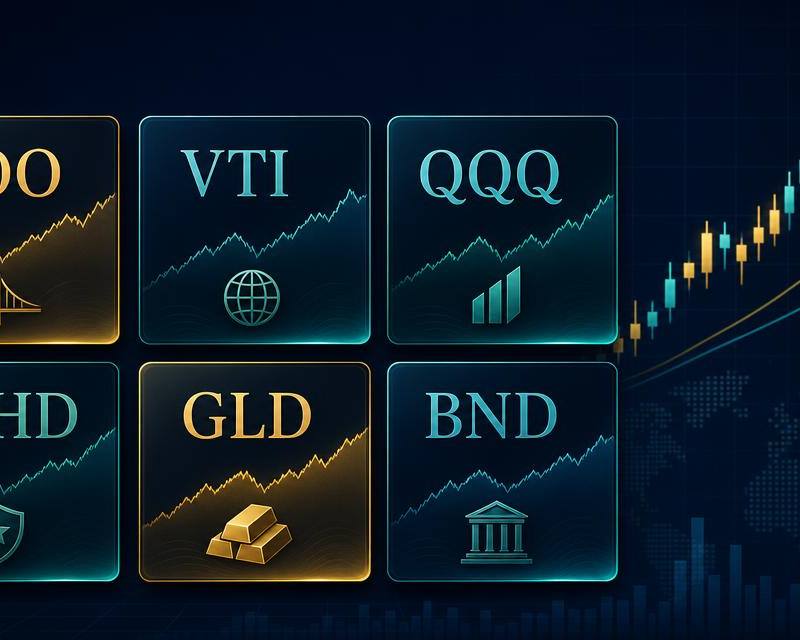
Short answer: there is no single best ETF. There is a best ETF for each job in a portfolio. For a US core, VOO or VTI at 0.03% are hard to beat. For growth, QQQ or VUG. For income, SCHD. For bonds, BND. For gold, IAU. For international, VXUS. Cost, index rules and the role the fund plays matter far more than last year's return — the table below sets out the strongest option in each category and who it actually suits.
Best ETFs 2026 at a glance
| Ticker | Fund | Category | Expense ratio | Best for |
|---|---|---|---|---|
| VOO | Vanguard S&P 500 ETF | US large-cap core | 0.03% | The default benchmark holding |
| VTI | Vanguard Total Stock Market ETF | US total market | 0.03% | One-fund US equity exposure |
| SPY | SPDR S&P 500 ETF Trust | US large-cap core | 0.0945% | Traders and options, not buy-and-hold |
| QQQ | Invesco QQQ Trust | Growth / tech | 0.20% | Concentrated Nasdaq-100 exposure |
| VUG | Vanguard Growth ETF | Growth | 0.04% | Cheap broad growth tilt |
| SMH | VanEck Semiconductor ETF | Thematic | 0.35% | Direct AI capex exposure, high volatility |
| SCHD | Schwab US Dividend Equity ETF | Dividend / quality | 0.06% | Income with a quality screen |
| VYM | Vanguard High Dividend Yield ETF | Dividend | 0.06% | Broader, lower-turnover income |
| VXUS | Vanguard Total International Stock ETF | International | 0.05% | Everything outside the US in one line |
| VWO | Vanguard FTSE Emerging Markets ETF | Emerging markets | 0.07% | Targeted EM exposure |
| BND | Vanguard Total Bond Market ETF | Bonds | 0.03% | Core fixed income ballast |
| TLT | iShares 20+ Year Treasury Bond ETF | Long duration | 0.15% | A rate bet, not a safety blanket |
| IAU | iShares Gold Trust | Gold | 0.25% | Cheapest large physical gold wrapper |
| GLD | SPDR Gold Shares | Gold | 0.40% | Deepest liquidity for large trades |
Expense ratios are the funds' published figures from issuer materials; they change rarely but should be checked on the fact sheet before you buy.
Best index ETFs: VOO, VTI and SPY
The core of almost every sensible portfolio is a broad, cap-weighted US index fund, and here the decision is close to a coin flip between two Vanguard funds charging the same 0.03%.
VOO tracks the S&P 500 — the 500 largest profitable US companies. VTI tracks the CRSP US Total Market Index, roughly 3,600 names. Because both are market-cap weighted, around 85% of VTI's weight is the S&P 500, which is why their returns rarely diverge by more than a fraction of a percentage point. We break the decision down in full in VTI vs VOO 2026.
SPY tracks the same index as VOO but charges 0.0945% and is structured as a unit investment trust, which prevents it from reinvesting dividends between distributions. It has the deepest options market of any ETF on earth, which makes it the trader's instrument — and the wrong long-term choice for most buy-and-hold investors. The full comparison is in VOO vs SPY 2026.
Verdict: VTI if you want one fund and nothing else. VOO if you want the benchmark and plan to bolt on satellites. SPY only if you trade options on it.
Best growth ETFs: QQQ, VUG and SMH
Growth funds have carried index returns through the AI capex cycle, and that is exactly the risk. QQQ tracks the Nasdaq-100, which excludes financials by construction and concentrates heavily in a handful of megacap technology names. It charges 0.20% — expensive next to VUG's 0.04% for a broadly similar large-cap growth tilt.
SMH is the purest expression of the AI trade: a concentrated basket of semiconductor manufacturers and equipment makers, dominated by a few names whose earnings hinge on datacentre capex budgets. It is a satellite position, not a core one, and it can draw down far harder than the index. Our NVIDIA stock forecast for 2026 covers how much of that cycle now rests on a single company's guidance.
Verdict: VUG for a cheap growth tilt inside a core. QQQ if you specifically want the Nasdaq-100's composition. SMH only in size you can afford to see halved.
Best dividend ETFs: SCHD and VYM
SCHD screens for companies with at least ten consecutive years of dividends, then ranks them on cash-flow-to-debt, return on equity, dividend yield and five-year dividend growth. That quality filter is why it behaves differently from a simple high-yield screen: it tends to hold fewer value traps, but it also owns very little technology, so it lags badly in growth-led years.
VYM is broader and simpler — market-cap weighted across above-average-yielding US stocks, with lower turnover and roughly 500 holdings. It is less concentrated than SCHD but has a weaker quality tilt.
Verdict: SCHD for quality-screened income; VYM if you want more names and less tracking error against the broad market. Neither is a bond substitute — both are equity funds and fall in equity drawdowns.
Best bond ETFs: BND and TLT
BND holds the investment-grade US bond market — Treasuries, agency MBS and corporates — at 0.03%. It is the ballast position: modest yield, moderate duration, and the thing you rebalance out of when equities fall.
TLT is a different animal. Holding only Treasuries with 20+ years to maturity, its duration is roughly three times BND's, which makes it a leveraged view on long-end yields rather than a safety holding. It fell heavily through the 2022–2023 rate cycle and remains highly sensitive to term premium. Buy it if you have a rates view; do not buy it because it says "Treasury".
Best gold ETFs: IAU and GLD
Both hold allocated physical bullion in vaults; the difference is cost and liquidity. IAU charges 0.25%, GLD charges 0.40%. Over a decade that gap compounds meaningfully, so IAU is the better default for a held position, while GLD's larger trading volume and tighter spreads suit institutional-size orders and options strategies.
Gold's role in 2026 remains a hedge against real-rate and currency risk rather than a growth asset — our gold price forecast for 2026 walks through how hedge demand and carry costs pull against each other.
Best international and emerging market ETFs: VXUS and VWO
US-only portfolios are a concentrated bet on one economy that happens to have won for fifteen years. VXUS covers developed and emerging markets outside the US in a single line at 0.05% — the simplest way to fix that. VWO isolates emerging markets specifically at 0.07%, which is a more deliberate allocation and considerably more volatile.
The practical rule: hold VXUS as the diversifier, add VWO only if you want EM weighted above its market share.
How to choose an ETF (in this order)
- Job first. Decide what role the fund plays — core, growth tilt, income, ballast, hedge. Never buy a fund because it performed well last year.
- Expense ratio. Within a category, the cheapest broad fund usually wins over long horizons. A 0.37% gap (GLD vs IAU) is real money over 20 years.
- Index methodology. Two funds with the same label can hold very different things. Read what the index actually screens for.
- Liquidity and spread. Check average daily volume and bid-ask spread, especially for thematic funds. Use limit orders.
- Overlap. Owning VOO, VTI and QQQ together is one bet in three wrappers. Check the top 10 holdings before adding a fund.
- Structure and tax. Open-end ETFs generally handle dividends and capital gains more efficiently than unit investment trusts like SPY.
The risk nobody prices in
Every broad US equity ETF on this list shares the same concentration problem. The largest handful of AI-linked megacaps dominate VOO, VTI, VUG and QQQ alike, and they overlap heavily with SMH. A derating in that group takes the "diversified" core down with the thematic satellite. Genuine diversification in 2026 comes from adding VXUS, BND and gold — not from owning four US equity funds.
If you are actively trading around these positions rather than holding them, our free trading signals cover the index and commodity setups these ETFs track.
Bottom line
A defensible 2026 portfolio can be built from four tickers: VTI or VOO for the US core, VXUS for the rest of the world, BND for ballast and IAU for the hedge — total weighted cost well under 0.10%. Everything else on this list is a deliberate tilt on top of that, and each tilt should have a reason you can state in one sentence.
This article is information, not investment advice. ETFs can lose value and past performance does not predict future returns.
For a dated, condition-aware view of which of these to buy this quarter, see Best ETF to buy now (2026): picks by goal and risk level.
Sources & methodology
Primary sources and datasets referenced in this article. How we source, verify and date our reporting is set out in our editorial policy & methodology.
- Vanguard S&P 500 ETF (VOO) fund profile— Vanguard · published 1 Jul 2026
- Vanguard Total Stock Market ETF (VTI) fund profile— Vanguard · published 1 Jul 2026
- SPDR S&P 500 ETF Trust (SPY) fund page— State Street Global Advisors · published 1 Jul 2026
- Invesco QQQ Trust fund overview— Invesco · published 1 Jul 2026
- Vanguard Growth ETF (VUG) fund profile— Vanguard · published 1 Jul 2026
- Schwab U.S. Dividend Equity ETF (SCHD) fund page— Schwab Asset Management · published 1 Jul 2026
- Vanguard High Dividend Yield ETF (VYM) fund profile— Vanguard · published 1 Jul 2026
- Vanguard Total Bond Market ETF (BND) fund profile— Vanguard · published 1 Jul 2026
- iShares 20+ Year Treasury Bond ETF (TLT) fund page— BlackRock iShares · published 1 Jul 2026
- iShares Gold Trust (IAU) fund page— BlackRock iShares · published 1 Jul 2026
- SPDR Gold Shares (GLD) fund information— World Gold Council / State Street · published 1 Jul 2026
- Vanguard FTSE Emerging Markets ETF (VWO) fund profile— Vanguard · published 1 Jul 2026
- SPIVA U.S. Scorecard — active vs index performance— S&P Dow Jones Indices · published 1 Mar 2026