Best ETF to Buy Now (2026): Picks by Goal and Risk Level
What ETF should you buy right now? A dated, condition-aware guide to the strongest ETFs for a core holding, income, safety, inflation and growth in 2026 — with costs and sizing.
Updated July 2026.
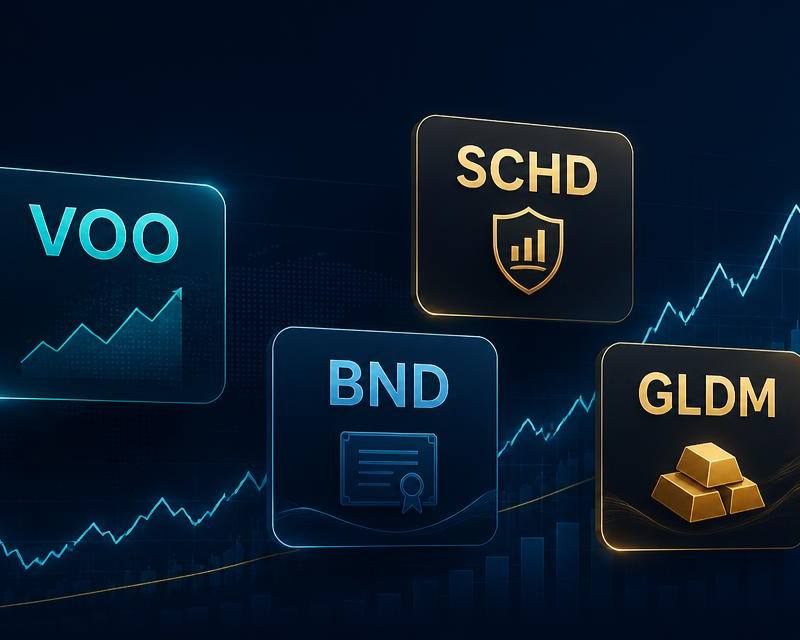
Short answer: if you are buying one ETF today, a total-market or S&P 500 core fund at 0.03% — VTI or VOO — is still the default. Add SCHD for income, BND or SGOV for ballast, GLDM for an inflation and crisis hedge, and VXUS if your portfolio is all-US. What has changed in 2026 is not the answer, but how much of each you should own.
What has changed this quarter
- Short rates still pay you to wait. Cash-like Treasury funds yield materially more than they did through the 2020-2021 cycle, so the opportunity cost of holding dry powder is real but no longer punitive against equities.
- The S&P 500 is unusually concentrated. The largest handful of AI-linked names carry a historically high share of the index. Buying "the market" today means buying more single-stock risk than it did a decade ago.
- Gold has had a strong run on central-bank buying and ETF inflows, which raises the bar for adding to a hedge you do not already own.
- Bonds finally have a coupon again. A total-bond fund is once again a genuine diversifier rather than a return-free risk.
Those four facts drive every pick below. None of them changes the case for owning a cheap, broad core — they change the sizing around it.
Best ETFs to buy now: the shortlist
| Ticker | Fund | Type | Expense ratio | What it is for |
|---|---|---|---|---|
| VTI | Vanguard Total Stock Market | US equity — total market | 0.03% | One-fund US core, ~3,600 holdings |
| VOO | Vanguard S&P 500 | US equity — large cap | 0.03% | The benchmark core everyone quotes |
| SPY | SPDR S&P 500 | US equity — large cap | 0.0945% | Trading and options, not buy-and-hold |
| VXUS | Vanguard Total International Stock | Ex-US equity | 0.05% | Diversifying away from US concentration |
| SCHD | Schwab US Dividend Equity | US dividend equity | 0.06% | Quality-screened income and lower beta |
| VUG | Vanguard Growth | US growth equity | 0.04% | Broad growth tilt at index cost |
| QQQ | Invesco QQQ Trust | Nasdaq-100 | 0.20% | Concentrated large-cap tech exposure |
| BND | Vanguard Total Bond Market | US investment-grade bonds | 0.03% | Portfolio ballast with a real coupon |
| SGOV | iShares 0-3 Month Treasury | T-bills | 0.09% | Cash you have not deployed yet |
| GLDM | SPDR Gold MiniShares | Physical gold | 0.10% | Inflation and crisis hedge |
Expense ratios are the issuers' published figures and change rarely — the sources at the end link straight to each fund page, so verify before you buy.
Best ETF to buy now, by goal
Core holding: VTI or VOO
If you only ever buy one fund, buy the broad US core. At 0.03% both are effectively free, and over the past decade their returns have been almost indistinguishable because the S&P 500 makes up roughly 85% of VTI by weight. VTI adds mid- and small-caps, which matters more in 2026 than usual precisely because the mega-cap share of the index is so high. We compare them in detail in VTI vs VOO, and if you are choosing between the two S&P 500 giants instead, read VOO vs SPY — the short version is that VOO is for investing and SPY is for trading.
Income: SCHD
SCHD screens for dividend quality — consistent payers with healthy balance sheets — rather than the highest headline yield, which is what makes it a defensible income core rather than a yield trap. It also carries far less mega-cap tech weight than the S&P 500, so it works as a partial answer to the concentration problem as well as an income sleeve.
Safety and ballast: BND or SGOV
With coupons restored, BND does the job a bond fund is supposed to do: pay you something while cushioning equity drawdowns. If your horizon is under two years, or you want to stage money into the market rather than commit it at once, SGOV gives you T-bill yield with almost no duration risk. Holding SGOV is not sitting out — it is being paid to wait.
Inflation and crisis hedge: GLDM
A mid-single-digit gold weight has historically improved portfolio behaviour in equity drawdowns without dragging much on long-run returns. GLDM at 0.10% is the cheapest way for most long-term buyers to own allocated bullion. If you want the full comparison including tax treatment, see Best gold ETF 2026: GLD vs IAU vs GLDM, and for where the metal itself may go read our 2026 gold price forecast.
Growth and AI exposure: VUG over QQQ
Most investors who want "AI exposure" already have it — the same handful of names dominates the S&P 500. If you want more, VUG gives a broad growth tilt at 0.04%, while QQQ costs 0.20% for a narrower, exchange-defined basket. Adding QQQ on top of a VOO core mostly means buying your ten largest holdings twice.
International: VXUS
The single most common gap in a 2026 portfolio is that it is 100% US. VXUS at 0.05% covers developed and emerging markets in one line. It is the cheapest available insurance against the possibility that the past decade of US outperformance does not repeat.
Beginner first ETF
Buy VTI, contribute monthly, and add nothing else until the contributions are automatic. Complexity added early is the most reliable way to underperform a two-fund portfolio.
How much, and when
The evidence favours lump-sum investing over drip-feeding on average, simply because markets rise more often than they fall. The evidence also says most people cannot sit through the drawdown that follows a badly timed lump sum. A workable compromise: deploy your core position now, stage anything that would make you anxious over three to six months in fixed amounts, and hold the undeployed part in SGOV so it earns something meanwhile.
A serviceable starting frame for a long-horizon investor: 60-70% broad equity core, 10-20% international, 10-20% bonds, and 5-10% gold. Shift the weights toward bonds and cash as your horizon shortens — not because of a market view, but because your time to recover has fallen.
What to avoid buying right now
- Stacking overlapping core funds. VOO plus QQQ plus a large-cap growth fund is one bet in three wrappers.
- Single-theme funds after the theme has run. Narrow thematic ETFs launch near peak enthusiasm and rarely beat a broad index over a full cycle.
- Leveraged and inverse products as investments. They reset daily and decay in choppy markets; they are trading tools with a horizon measured in days.
- Paying 0.0945% for the same index available at 0.03% unless you specifically need SPY's options market.
For the wider list of category winners beyond this quarter's picks, see Best ETFs 2026: top picks by category. Traders wanting shorter-horizon index and gold setups rather than fund allocations can follow our desk on the indices signals hub.
Risks
Every fund here can lose money, including the bond and gold funds. Index concentration means a broad US ETF is more exposed to a handful of companies than its 500-stock label suggests. Bond funds fall when yields rise. Gold can trade sideways for years. Expense ratios, holdings and index rules change — verify against the issuer documents before you act. Nothing here is investment advice or a recommendation to buy any specific security.
Sources & methodology
Primary sources and datasets referenced in this article. How we source, verify and date our reporting is set out in our editorial policy & methodology.
- Vanguard Total Stock Market ETF (VTI) profile— Vanguard · published 1 Jul 2026
- Vanguard S&P 500 ETF (VOO) profile— Vanguard · published 1 Jul 2026
- SPDR S&P 500 ETF Trust (SPY) fund page— State Street Global Advisors · published 1 Jul 2026
- Vanguard Total International Stock ETF (VXUS) profile— Vanguard · published 1 Jul 2026
- Schwab U.S. Dividend Equity ETF (SCHD) fund page— Charles Schwab Asset Management · published 1 Jul 2026
- Vanguard Growth ETF (VUG) profile— Vanguard · published 1 Jul 2026
- Invesco QQQ Trust fund page— Invesco · published 1 Jul 2026
- Vanguard Total Bond Market ETF (BND) profile— Vanguard · published 1 Jul 2026
- iShares 0-3 Month Treasury Bond ETF (SGOV)— BlackRock iShares · published 1 Jul 2026
- SPDR Gold MiniShares Trust (GLDM) fund page— State Street Global Advisors · published 1 Jul 2026
- S&P 500 index concentration and constituent weights— S&P Dow Jones Indices · published 30 Jun 2026
- Federal Funds Effective Rate and Treasury yields— Federal Reserve Bank of St. Louis (FRED) · published 1 Jul 2026
- Gold Demand Trends and global gold ETF flows— World Gold Council · published 30 Apr 2026