
Academy
Gold Trading Courses
Free, 20-lesson Gold (XAUUSD) trading courses from MarketsHQ Academy — Beginner, Intermediate and Advanced — with per-user progress tracking.
About the MarketsHQ trading courses
MarketsHQ Academy publishes structured, free trading courses built around Gold (XAUUSD) — the world's most-traded commodity. Each flagship course contains 20 progressive lessons, follows a clear Beginner → Intermediate → Advanced path, and comes with per-lesson progress tracking and a course-completed badge for signed-in users. No paywall, no subscription — just a repeatable process for reading gold, timing trades and managing risk.
Last updated:
How the courses work
- 20 structured lessons per course, each 5–10 minutes of focused reading with concrete examples.
- Progress tracking for signed-in users — every completed lesson updates your percentage automatically.
- Completion badge with the finish date once every lesson in a course is marked done.
- No prerequisites for Beginner; Intermediate assumes chart-reading basics; Advanced assumes an active process.
Choose your course
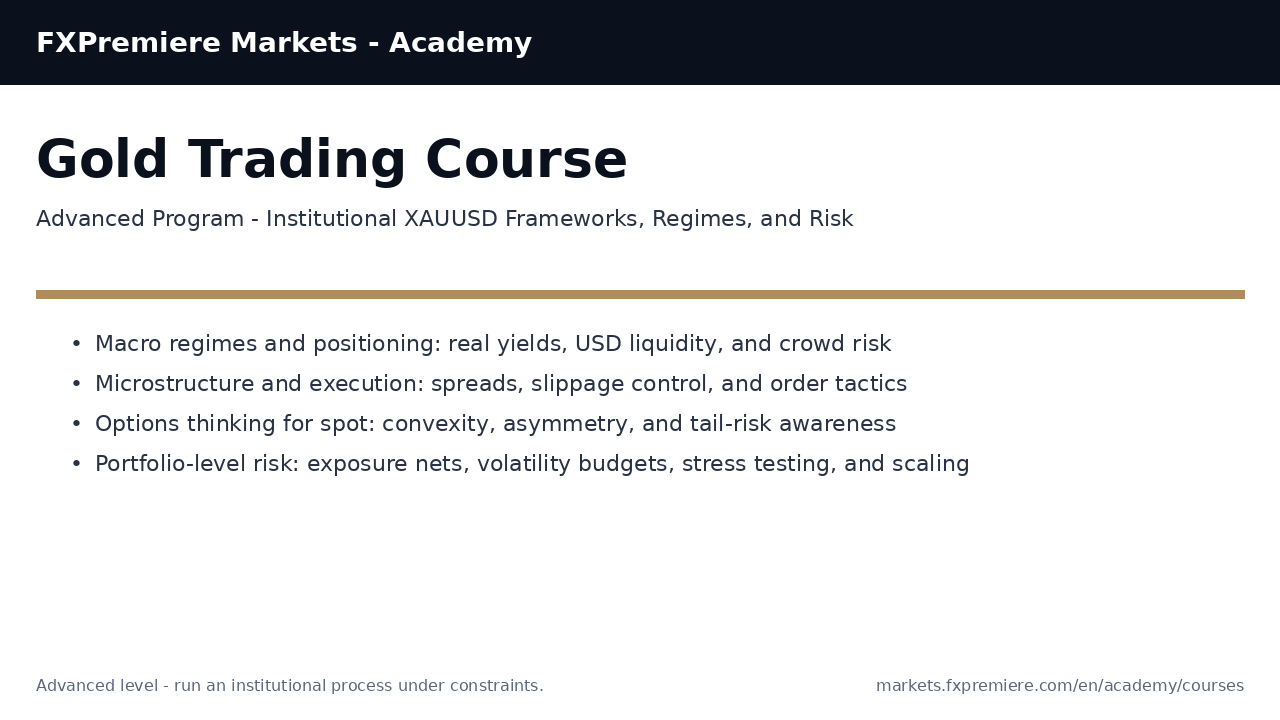 advanced
Gold (XAUUSD) Trading Course - Advanced (20 Lessons)
This Advanced Gold Trading Course (XAUUSD) is built for traders who already know the basics and want to trade gold with a more institutional process: regimes first, execution quality, portfolio constraints, and disciplined decision-making. Instead of chasing indicators, you learn how professionals think in macro regimes (real yields, USD liquidity, risk premia), how they navigate liquidity and microstructure (spreads, slippage, order tactics), and how they control downside with volatility posture, exposure caps, and stress testing. Across 20 structured lessons, you will build a desk-grade operating system for gold: multi-timeframe decision zones, state transitions and path mapping, liquidity sweep logic, options-style thinking for spot traders (convexity, asymmetry, tail risk), and event frameworks for CPI, FOMC, and NFP. The course includes images, checklists, quizzes, and implementation worksheets so you can convert concepts into a repeatable playbook. Best for: intermediate traders moving to advanced execution, traders scaling size, and anyone seeking a professional gold trading strategy approach for XAUUSD that prioritizes process and risk control. You will learn to: Trade gold by regimes and define posture rules (normal, reduced, flat) Improve fills with microstructure-aware execution and order selection Use volatility regimes to scale risk and frequency intelligently Build portfolio-level risk controls (net exposure, cluster caps, vol budgets) Trade events with scenario trees and post-event structure plans Run weekly attribution to reduce error tax and scale sustainably Educational content only, not financial advice.
20 lessons · 3h 20m
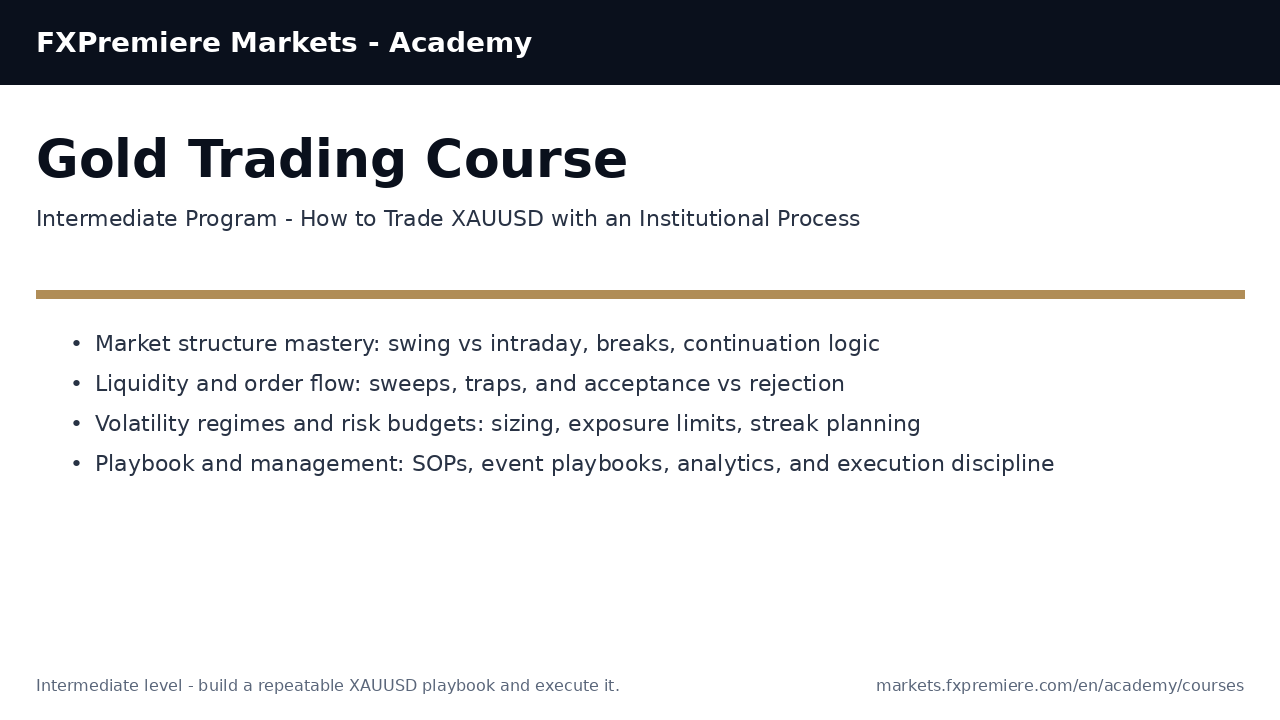 intermediate
Gold (XAUUSD) Trading Course - Intermediate (20 Lessons)
This intermediate course teaches you to trade gold (XAUUSD) with a professional, process-driven approach across 20 structured lessons. You will move beyond basic chart patterns into swing vs intraday market structure, liquidity dynamics (stop runs, sweeps, and how institutional flow shapes highs and lows), and higher-timeframe context that keeps you on the right side of trend continuation and reversal. Lessons cover premium/discount zones, order blocks, fair value gaps, session-based execution (Asia, London, New York), correlation with DXY and real yields, risk sizing, and building a repeatable trading plan with journaling and review. By the end you will have an institutional workflow for reading XAUUSD, timing entries, and managing risk with discipline. Educational only; trading involves risk.
20 lessons · 3h 20m
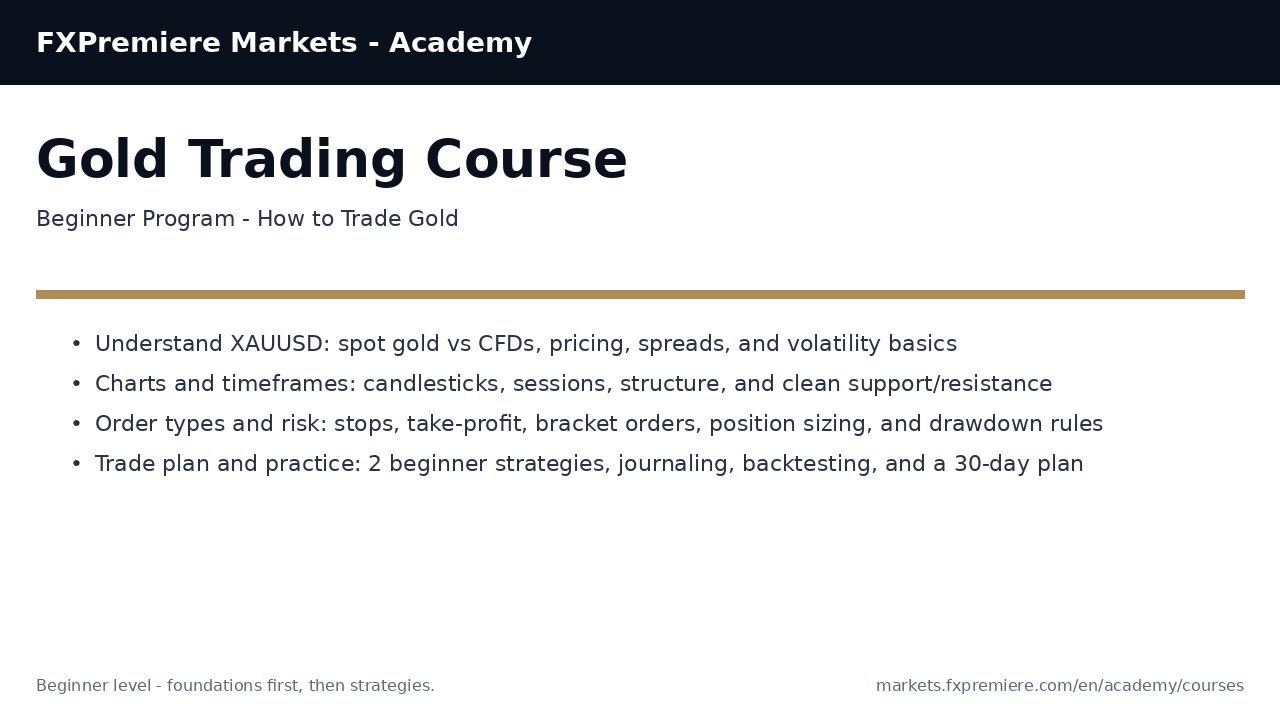 beginner
Gold (XAUUSD) Trading Course - Beginner (20 Lessons)
This beginner course guides you through the essentials of trading gold (XAUUSD) in 20 structured lessons. Start with the basics of what XAUUSD represents and how spot, futures, and CFD markets work, then move into chart reading, timeframes, trading sessions, and why gold’s volatility behaves the way it does. You’ll also learn the tools, terminology, and workflows used by new traders and finish with a practical 30‑day plan to build disciplined habits and risk awareness. Educational only; trading involves risk.
20 lessons · 3h 20m
Frequently asked questions
- Are the MarketsHQ trading courses free?
- Yes. Every course in MarketsHQ Academy is free to read, with no paywall and no subscription. You only need a free MarketsHQ account if you want per-lesson progress tracking and a course-completed badge.
- Do I need a broker account to follow the courses?
- No — the lessons are educational and can be studied without a live account. When you are ready to practice, most brokers offer a free demo account so you can apply the material risk-free before trading real capital.
- How long does each course take to complete?
- Each flagship gold (XAUUSD) course contains 20 structured lessons of roughly 5–10 minutes each, for about 200 minutes of core reading per course. Most learners finish a course in one to three weeks alongside their normal schedule.
- What is the difference between the Beginner, Intermediate, and Advanced courses?
- Beginner covers the fundamentals of XAUUSD, charts, order types, and a first 30-day plan. Intermediate moves into market structure, liquidity, sessions, and building a repeatable playbook. Advanced focuses on institutional process: regimes, execution quality, portfolio constraints, and disciplined risk control.
- Can I track my progress through a course?
- Yes. Signed-in users get automatic lesson-by-lesson progress tracking, a visible completion percentage on the course page, and a 'Course completed' badge with the completion date once every lesson is marked done.
- Is there a completion certificate?
- When you finish every lesson in a course, MarketsHQ marks the course completed and records the date on your profile page and on the course itself. There is no paid certificate — the completed badge is the recognition.
- In what order should I take the courses?
- Start with the Beginner Gold (XAUUSD) course to build the foundations, then move to Intermediate for structure and execution, and finish with Advanced for institutional-grade process and risk control. Each course is standalone but the progression is designed to compound.